*INSERT IMAGES
On a rainy Sunday afternoon I cuddled myself up on the sofa and started reading a book that had been on my list for a while. I opened my book ‘Alice in Wonderland’, and found myself tumbling down in a fantasy world.
It all starts with a white rabbit wearing a waistcoat. How odd is that? Curiosity takes the better of you and what harm can it do to follow such a pure white rabbit? He must be innocent. Alice follows the rabbit and this immediately shows Alice’s innocence and ignorance, as she has no fear following a stranger into a dark, deep place. This is where the adventure starts, and adventure plays a key role in the book.
Alice’s curiosity leads her into a beautiful world, but finds herself constantly in doubt and compromising situations. She does, however, manage these situations whilst in the meantime growing and shrinking in size. Her skills, competences and sense of self in this new cultural setting is put to the test. (Appleyard, 1991)
Alice meets various creatures during her adventures. One of the creatures she meets is a caterpillar. “Who are you?” said the caterpillar. This was not an encouraging opening for a conversation. Alice replied, rather shyly, “I-I hardly know, Sir, just at present – at least I know who I was when I got up this morning, but I think I must have been changed several times since then.” (Carroll, 2006 pages 43 and 44). This shows Alice constantly doubts who she is. The animals in the book could be a personification of adults and as Alice grows and shrinks in size, this could mean her forming relationship with adults.
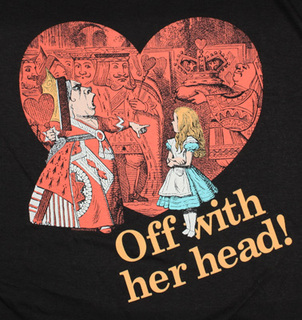
Death is constantly luring, although no harm is being done. In the final trial the Queen of Hearts has an enormous desire to execute her citizens. The Queen has Alice standing trial. “Imagine her surprise, when the White Rabbit read out, at the top of his shrill little voice, the name “Alice!”” The Queen even tries to execute Alice, but Alice, being taller (grown-up) stands up to the Queen and talks her out of doing this. Standing up to the Queen may mean her childhood has died and being a grown-up now.
The group discussion was all about whether the end of the book gives the reader a solution. Were we satisfied at the end? The ending leaves the reader unsatisfied, as there is no clear answer. Alice wakes up in the real world, the world of adults and her sister reflects on this when Alice walks away. An older reader can furnish an ending, whereas younger readers need to know the ending in the story.
The book is easy to read, because it has uncomplicated sentences and the narrative structure is fairly elementary. The suitable age group for this book would be from 6 years up until 12 years. For the ages 6 up to 9 years it is a nice book as it is easy to read and it has a few images. Adventure plays a key role in the book, and this makes it very suitable as a children’s book. (Appleyard, 1991) For the age range 9-11 it can help you to figure out who you are and who you could become. (Withers & Ross, 2011)
Currently, my 9-year old son is reading the book and he loves it as the adventures follow quickly after another.
Bibliography:
Appleyard, J.A. (1991). Becoming a Reader: 1 The Reader as Hero and Heroine. Cambridge: Cambridge University Press
Carroll, L. (2006). Alice’s Adventures in Wonderland and Through the Looking-Glass. London: The Penguin Group
Erikson, E.H. (1970). Reflections on the dissent of contemporary youth. International Journal of Psychoanalysis, 51, 11-22.
Withers, H. & Ross, L. (2011) Young people are reading more than you. https://hubl.hu.nl/archive/file/23154 Retrieved 16 February 2020.
Image White Rabbit. Retrieved from: https://i.pinimg.com/originals/89/65/1e/89651efa30c243597209181938187ea3.jpg
Image Caterpillar. Retrieved from: https://i.ebayimg.com/images/i/160692164186-0-1/s-l1000.jpg
Image Off with her head. Retrieved from: http://s3.amazonaws.com/rapgenius/Alice_Wonderland_Off_Head_Black_Babydoll.jpg
 Love2Read Youth Literature